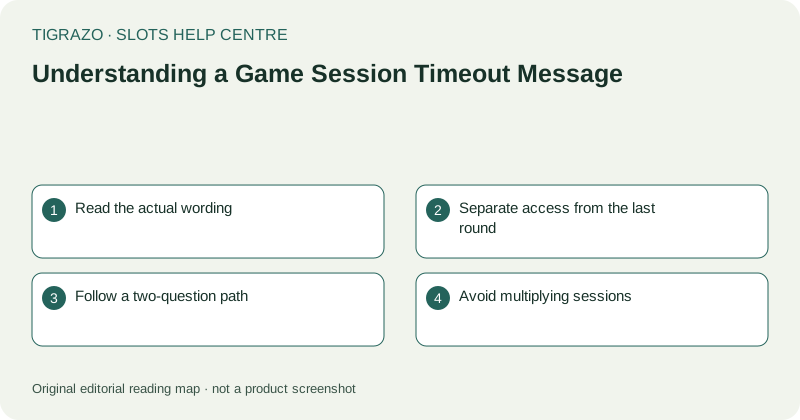
Read the actual wording
Messages that mention inactivity, connection expiry or authentication may look similar but describe different conditions. Copy the exact text if possible. Do not translate every interruption into a claim that the whole service has failed.
Check whether the notice gives a normal recovery instruction, such as returning to an account page. Follow only familiar, legitimate navigation. Do not enter credentials into an unexpected pop-up or follow an unsolicited recovery message from another source.
Separate access from the last round
A timeout can occur before an action, after a settled result or during an uncertain transition. Those positions matter. If you had not initiated anything, access restoration may be the only issue. If an action may have been accepted, its recorded state needs separate verification.
Neither an expired page nor a new sign-in proves that an earlier round was cancelled. Likewise, a saved image of the last reels does not prove that they represent the final record.
Follow a two-question path
First ask whether any round is unresolved. Then ask whether ordinary access can be restored through the stated process. Keeping those questions separate avoids treating a successful login as a complete technical explanation.
- Stop game input when the timeout appears.
- Record the message, approximate time and last action.
- Use the normal sign-in or return process if appropriate.
- Inspect available recorded history for the affected round.
- Contact support if the record is unclear or inconsistent.
Do not start a new round to see whether the timeout has gone away.
Avoid multiplying sessions
Opening several tabs or devices can create more conflicting messages. One view may be expired while another has restored access. Use a single clear path and avoid concurrent copies while investigating.
If you are on a shared device, remember that closing the expired game frame may not sign out the wider account. Once the incident is understood, use normal sign-out controls as appropriate rather than relying on the timeout to protect access.
Escalate the unresolved part
A good support request identifies whether the remaining problem is inability to sign in, inability to open the game or uncertainty about a round. Include the exact timeout wording and relevant private round identifier if available.
There is no need to invent a cause such as server overload. A factual symptom record is enough. Restoring a session solves an access issue; the recorded round history or support response establishes any outcome that remained uncertain during the interruption.